Wednesday, February 20, 2013

Why sign language with your baby will work for you - FUN, EASY, & AMAZING

 Within my own family and friends, I have the skeptics about using sign language with my daughter or thinking it will be successful for their children. I understand people's opinions are all different and I never press the issue. But man, if they only knew the benefits! 

It has to be a hit right? I mean we see so many television shows incorporating some sign language here and there (e.g. Little Bill in Nick Jr and The Good Night Show on Sprout and even the Signing Time songs during commercial breaks themselves). It's a success! It's a hit! It's educational! And most importantly for your child - it's fun!
Little Fingers & a friend signing EAT
while playing with their kitchen set

Nothing is more FUN than seeing your child sing, sign, and dance around the room like my Little Fingers as she's so interested in learning MORE MORE MORE! You can start as early as 6 months old and trust me not using sign language takes all the fun away of that guessing game we like to call fit-throwing when we don't know what it is they want and they have no means of communicating it to us at that time. It's FUN to sign!


Super EASY!
Some of my parents in classes take the approach initially that this is more work or homework for them because they don't have the background I have in sign language. Well, you certainly don't need the background I have in sign language to make it EASY! We're looking for one-word phrases and utterances not a long winded sentence! To start, you pick a few signs and go from there. Bombardment isn't necessarily key anyway. First few signs - - - probably something highly preferred (e.g. MILK, MORE, MOMMY). Keep it EASY and the FUN will last forever :) 

The Wow - AMAZING moments...
I have had so many 'Wow - AMAZING' moments during Little Fingers communication and language development - I truly attribute it to her knowledge in sign language. She's been signing since she was about 8 months. She's 23 months now and she speaks in 3 - 5 word sentences (don't get me wrong we still have 1 and 2-word sentences too!). She still watches her Signing Time videos, especially the newest series Rachel and the Treeschoolers and it AMAZES me.
                                                                  
                                               This is the newest video in case you haven't seen it yet

 She signs things I never taught her or focused on (e.g. CHEESE). She has such a diverse vocabulary, it's AMAZING!


EASY 

FUN 

AMAZING ...


What more can I say!

Friday, January 25, 2013

What's the differences between sign language and baby sign language

I always run into the comment, "Oh it's so nice (or so cute) that you're teaching Little Fingers baby signs!" ... and I cringe. Depending on the person and situation, I smile and says, 'thanks' and continue on. Other times I may say, 'Well we use real concepts from American Sign Language' ... or something along those lines.

Or when I am teaching Mommy & Me or did my research study in 2008, I emphasized 'sign language with babies' - this concept is very different than Baby Signs! I know it's easier to say Baby Sign Language but... they are not one in the same.

Why do I make such a big deal out of this? Because research warrants the amazing results with ASL concepts for babies. When I first starting teaching sign language to others, one of my favorite lines to say came from Joseph Garcia from Signing With Your Baby... It Takes A Language to Learn a Language! 


American Sign Language is a legitimate language (We've already talked this topic before, click here!). The quick of it is - Baby Signs is not a true language. .. which is a shame because the origin of Baby Sign came from two wonderfully educated women who did substantial research proving using gestural communication with infants and toddlers promotes language development, positive social skills, joint attention and all other positive communication skills. (I am not one to bash other people or companies, so I prefer to keep things nameless if that's ok with you). 

BUT... Baby Signs does not use all concepts in ASL and creates some fake signs. For example, the sign 'bird' is a person flapping like they have wings. The sign BIRD in ASL is the pointer finger and thumb at the mouth/chin like a bird's beak. (keep in mind the sign BIRD in ASL is capitalized, because it is considered 'glossed'. Remember that discussion? Click here!)


Why is this important?
Before going into a dissertation on the topic, the highlights are:

  • it takes a language to learn a language
  • carry over is inconsistent with Baby Signs. If a child is taught homemade signs and signs that accommodate their lifestyles, they cannot use them in other settings (e.g. daycare, community, school, etc).
    • sign language reduces the guesswork in a toddlers/infants' thought process with their communicators (e.g. parents). If their signs are made up, then the guesswork comes back! That's not fun! It's like the pointing game. While a infant/toddlers first gesture is the point and it's extremely meaningful and effective... after a certain it's important to move away from the point Katie @ PlayingWithWords365 wrote a great blog post about the importance of pointing (click here!).
  • ASL is not taught to infants and toddlers for its grammatical concepts, which is where people get confused. But using real gestures that mean something to more than the person who created them (e.g. mommy or daddy) leads to easier growth and learning for the child. 

I just emphasize to moms and dads looking for a sign language class, book, and/or DVD for your infant or toddler to make sure it's not actual Baby Signs. There are many companies that promote ASL concepts. By no means are we discussing ASL using the language concepts grammatically-speaking (e.g. mouth morphemes, etc. - now that's another day's discussion for sure!) - but using true signs will help with language and communication growth. 


Ms Little Fingers signing HORSE
(this is the end of the sign for her)
P.S I didn't realize how hard it is to get her to pose
for a signing pic! LOL!
I am aware of the fine motor concerns with infants and young toddlers and it's reasoning to creating Baby Signs. I still have the same feelings though. What I teach my moms and dads is this: sign the sign as it's supposed to be signed. If your little one signs it incorrectly, don't necessarily always correct them, but you keep signing it correctly. Modeling is key! They think they are signing it right - I promise! As they continue to develop,  so will their signs! You can see from Ms Little Fingers signing HORSE - she's not on the top of her head like she should be. .. I continued to model it with positive praise that she was signing it correctly ... her handshape was correct (she moved her two fingers like the horse's ears), ... it was just a couple inches off of where it should have been! Don't worry folks - I didn't break the bank over it. And guess what, she's since signing it correctly!

If you are looking for a class, check SigningTime Academy. If they don't have instructors in your area, let me know. I know a few other great companies that might be able to help!

Happy Signing!

Saturday, December 15, 2012

Sign Language Success! Guest Post from one of our Winner of Giving Thanks Week


Sign Language To the Rescue!

Read this great story how sign language helped this grateful family (she was also one of the winners to our Giving Thanks Week during Thanksgiving).

                                                                                                             
            Sign Language has played a substantially important role in my family's life. Our daughter Iliana, who is now 7 years old, was born with several disabilities. I remember when she was 3, she was still not picking up speech; her four words were "Dada, Momma, night, & bye bye". We tried everything from speech-language pathology at the hospital to OT and Speech classes several days a week at home, but to no avail. We attributed this learning/speech delay to her extensive brain damages previous to birth. At that age of 3, she also received her tracheostomy tube and it was the last time I ever heard any of those four words from her again. You can imagine the devastation we felt even if it was only four words. 

             However, one day my sister mentioned teaching her some simple signs and that she may even learn to communicate back with us. This opened up new opportunities for our family. 

             Iliana is now signing single words - a word to describe what she wants to do or what she would like (for example, her toy phone).  She knows many basic signs! I know the frustration that parents and children who can't speak feel, when communication between each other is just not there. Your child wants something but doesn't know how to communicate it, leaving us to guess. Daily life can be dramatically improved starting with just basic signing. The signs for milk or eat, play, happy, sad, hurt, and etc. has helped us greatly!

            Now that Iliana is a little older she is able to ask me for things. She has to sign things in the room that she sees, instead of crying and pointing. This really makes me so happy, and I know she is eager to learn more! One thing I’ve learned about using sign language is that you don't have to be an expert at using it. I am no expert and am still continuously learning all the time. However it is also not impossible to remember the new signs, while learning. So, do not be discouraged if you are thinking about learning as you go, and teaching your child.

            Our favorite ways to learn together has been by using Flash cards, iPad apps, Rachel Coleman's Signing Time DVDs, and recently we were generously gifted the book, Signing Time Play Time Signs, which is a wonderful picture teaching book that she will enjoy over and over! (Thank You, HearMyHands). ASL is not just for deaf and hard of hearing, but an awesome tool for special needs children and adults, or anyone with the desire to learn. I am so grateful we have this amazing language, because communicating with Iliana has been a true joy and we look forward to learning more together, every day!

Tina Shupe


Thursday, May 10, 2012

sign: MEET Speech LANGUAGE pathologist Ashley from Talk It Up

It's still Better Speech and Hearing Month and we want to celebrate with a post from Ashley, creator of Talk It Up


Meet Ashley founder of Talk It Up. She has some great things to say about her thoughts on using ASL in speech-language therapy. 


When did you first learn about ASL? Or first gain interest in ASL?
I was first introduced to ASL in 5th grade.   My teacher taught the class how to sign the Pledge of Allegiance and we signed along to it every morning at the beginning of our day.  I instantly fell in love with this “new” language.  I wanted to know more!  From there, I self-taught myself the alphabet and some basic vocabulary.  Years later, I took a Master’s level course, Sign and Culture of the Deaf.  Not only did I learn exceptionally more signs, I learned about the culture of people typically using ASL.  To this day, I enjoy using and learning about ASL. 

How do you use sign language in your current job setting?
My job as a Speech-Language Pathologist allows for opportunities to use ASL in the educational setting.  While none of my students use ASL for their primary means of communication, I have found ways to work it into our day. 

How do you incorporate ASL in your therapy?
The first way I incorporate ASL into my speech/language therapy classroom is to use signs as visual cues.  I have one student who speaks entirely too fast.  I use the sign for SLOW DOWN to remind him to use a slower rate of speech.  Since this visual cue was working in my room, I shared it with the student’s teachers.  We are all in agreement that using a sign rather than a written visual cue is less intrusive and will be easier to fade out.  


I have also used signs to cue students to speak LOUDER, give MORE detail, and to stay seated SIT.
I also incorporate ASL in my therapy setting by signing during routine game play.  I have a student who has a difficult time asking and answering questions.  We play 'Go Fish' to help with this skill.  I taught him the signs that correlate to “Do you have?” and “No, go fish.”  Because of this student’s strength in visual learning, he was able to pick up on the routine of the game after learning the signs.  I slowly added speech along with the signs which allowed the student to independently play the game with peers.  The student and his peers still sign along to the question/response because they enjoy the motoric movement. 

What’s your next step with ASL in speech therapy? Any thoughts?
My next step is to incorporate more ASL into therapy sessions.  Next year, I’m planning to teach the sign that correlates to our vocabulary word of the week. 

Why do you think ASL is successful for some of our students in therapy?
With the higher functioning students on my caseload, teaching ASL in conjunction with spoken language can be successful because it is fun and motivating.  Also, I have found that teaching sign is great for the kinesthetic learners on my caseload.   However, all of my students are more attentive when sign is incorporated in therapy. 

Ashley McGeehon, CCC-SLP is a certified Speech-Language Pathologist who resides in the Midwest.  She works with students in grades 1 through 8 in the public school setting and in her own private practice, Talk It Up Speech and Language Therapy.  She also writes a blog to share ideas with other educators.  Check out her blog for more great therapy ideas.  
http://talkituptherapy.blogspot.com/

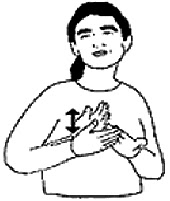
  The sign Language is L's wiggling outward as you can see from sign 1 to sign 2 (or in the video below).


Monday, January 2, 2012

Wish the baby knew the sign HELP

Friday night I was feeding Lil some apples that I was peeling and pureeing some for her to make baby food. She loved munching on the whole peeled apple with her teeny gnawing marks on what appears to be a large apple in front of her small face. So I peeled a single thin layer of the apple off for her to nibble on. The family was in town for the New Years weekend and Cmas part II. We were all around the kitchen table. I proceeded to get the food processor out and begin making her food when my sister called out, "something's wrong. .. Something's wrong!" Some reason I didn't take her seriously, but the next thing I knew I turned around and my husband was performing acts we learned in our annual CPR classes! Lil was truly choking! Her face was as red as the original apple before I peeled it. Her eyes were huge ... she was so scared!

Thinking back, I wonder wow it would be nice if she learned the sign for HELP relatively quickly ugh?...  Not that she would have it in her to sign HELP when she's choking, but I know there will be more times in her life in the near future that could be of benefit to know the sign HELP. So ... sign of the week: HELP!

Saturday, December 31, 2011

Welcome to HearMyHands

Welcome Welcome! We're new the world of blogging but with the New Year approach, it's our goal to reach out to you better by providing some great information about HearMyHands, Sign Language, Deaf culture, and other related topics!

HearMyHands has been in business since 2008 offering classes for all ages: Mommy & Me, Adult Conversational Sign, and just plain customized tutoring. Stay tuned for all our most up to date information including classes forming in late January and February.  Also Check us out on Amazon for some great products sold http://www.amazon.com/shops/A3NHA1FMYKSINW 
... and Facebook for some other great sign language followers and posts! www.facebook.com/hearmyhands

Happy New Year! Make it count!

Happy Signing!
~ Kristy
Master Certified Instructor, Signing Time
www.facebook.com/hearmyhands
hearmyhandsllc@gmail.com

Copyright © 2012 · Designed and Customized by: Virtual Boutik © All Rights Reserved.